Thursday, August 22, 2019

Turnabout Racing


 By Jesse Deupree

The first boat I ever raced was a Turnabout, a wonderful small plywood catboat developed and named by a man called Turner. Turnabouts were as common as seagulls in many Maine harbors in the late fifties and sixties, and probably about as popular with other yachtsmen when flocks of them took over a harbor or channel. I began racing as crew, but soon graduated to skippering my family’s boat when my older brother moved up a size in our Yacht Club’s fleets.         
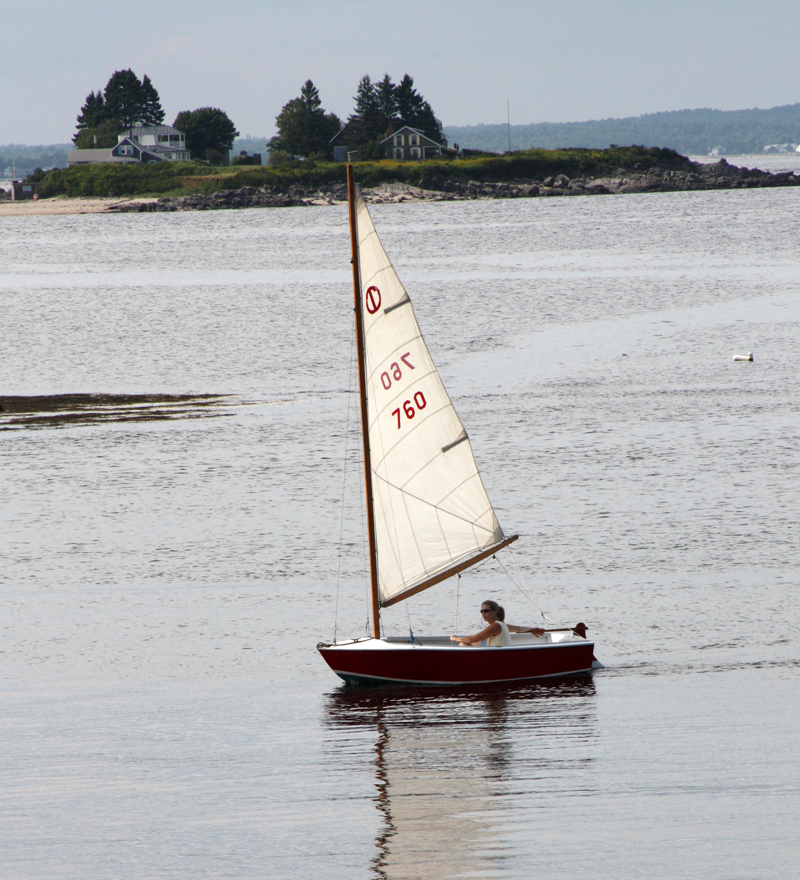
A Turnabout sails past  Basket Island
For me, sailboat racing has always been a means to an end. There are times when I have come ashore after a race and commented about a bird I saw, or the way the clouds looked, and received a blank stare in return from someone who may have been more concentrated on the race itself. I admit that if I had won the race in question, the conversation felt more enjoyable, but many of the lessons I have learned from racing (or sailing in general for that matter) have not been easy. “Winning makes you bigger, losing makes you stronger” comes to mind.
 
Those early races taught me about wind and water and whether to pass a given buoy to starboard or to port. I also learned about human nature.
I remember one race well. The course was set inside Monument, Negro and Wood Island – the islands that protected the small Turnabouts from the bigger ocean waves -- using three government marks: a black can, a nun, and a red and black can. 

The sea breeze had steadied and filled in, so the course was twice around a triangle, with a final beat to the finish at the black can that lay at the entrance to the outer harbor. I had taken the lead on the first two triangles. My friend Billy lay a decent second, but the race was mine to win.
As I rounded the leeward mark for the second time, I came across Maggie, who had snagged the mark on her first rounding and become quite stuck. Her mainsheet had caught the mark and pulled the end out of her hand, leaving the knot at the end of the sheet jammed in the block on the boom, beyond her reach, with her sail full and her boat pinned by the wind in a way she could not free. She was not in danger, she was not asking for help, but she was in a predicament, and I sailed right by.
 
Let me say that this story should carry no undertone that women don’t sail as well as men. Sailing was an equal opportunity sport even then. Boys and girls competed equally, no quarter asked or given, especially because we were young enough that other considerations had not occurred to any of us. If I thought anything, it was that Maggie should use her knife, which we were all required to carry, and which most of us kept in a pocket of our shorts, secured with a lanyard, as a badge of professional honor. Besides, I had never been shown how to ask for help.
To my surprise, Billy stopped and set Maggie free. I would ask him what he was thinking that day, but that would require that he remember the incident the same way, and if he didn’t, more would be lost to me than gained. I remember her smiling at him a year or so later during our first game of spin-the-bottle, so perhaps he had an early inkling of those other considerations. Whatever his reasons, his delay meant that my victory was assured, and I set out on a long starboard tack to the layline to the finish.
Billy, smart enough to try something other than following me home, set off on port, which immediately cast him against Monument Island, requiring a series of tacks along the shore. I don’t know at what point he realized he was on to something, I know I didn’t until it was far too late. The fact of the matter was that he had sailed out of the now strengthening tide, and had discovered a tactic that became standard practice for us all in short order. My long final port tack to victory became a slog to second place as Billy came roaring into the finish on starboard, avoiding the tide until the last minute, and easily taking the win.
 
If he felt satisfaction that day, he deserved it. Virtue may be its own reward, but not only had he saved the damsel in distress, he also got the prize. In hindsight, things turned out fine for me as well. I got two lessons, one of which was which side of the course to favor on the outgoing tide. 
 

Monday, August 5, 2019

The Russells: Sharing With Everyone


by Janice Hamilton

If you are new to the Pool, there’s a good chance you have never met Gordon Russell. He is a quiet person and doesn’t participate in many of the summer social or sports activities. The best chance to run into him is at the July 4 parade, when he usually rides in an army Jeep honoring veterans.

Despite his low-key presence, Gordon and his parents, Jane and Joe Russell, have made big contributions to Biddeford Pool over the years, notably granting a conservation easement of the land they own at East Point to the Maine Audubon Society so everyone can enjoy it.

Gordon Russell, 2017 July 4 parade
Gordon’s grandparents were the first family members to discover the Pool. His mother’s father, Dudley J. Hard, was a Cleveland businessman who noticed that a lot of steam generated by Cleveland’s many industries was going to waste. “He saw a way to make a buck out of it by harvesting industrial steam to generate electricity,” says Gordon. “He made a fortune.”

When Dudley Hard and his wife Mildred started summering at the Pool, they stayed in various guest houses. In 1930, they bought the big white house where Gordon still lives (on the north side of Lester B., second house past the croquet courts).

“My grandparents had a strong attachment to Biddeford Pool and that came down through my mother to me,” says Gordon. “Every year of my life, I have spent the summer, or part of the summer, here.”

When Gordon was a child, the Russells lived in Cleveland, where Joe was a businessman. In the late 1960s, they began to feel unsafe there because of growing racial tensions, so they had the Pool house winterized. As of 1970, the family split their time between Biddeford Pool and Hilton Head, South Carolina.

“My mother knew everybody around here and was a great friend of the Dupees and the Oldershaws,” Gordon recalls, while his father loved to play golf. “My memory of my father is of him with his clubs, passing through the hedge to the golf course every day.”

Gordon has been a Maine resident for almost 50 years. He attended St. Francis College (now the University of New England), and he lived at the Pool until he got married in 1978. He and his wife and two daughters lived in Saco, but Gordon returned to the Pool after his divorce in 2000 and he lives here year-round with his partner, Susan Shorey. He admits that February is difficult, but “I have two elderly cats and I can’t leave them, so I stay and I shovel.”

Reading about history and archaeology keep him busy. His interest in military history in particular stems from family history. Grandfather Hard served in the Spanish-American War and fought briefly overseas toward the end of World War I, while Joe Russell served in Europe during World War II and trained troops at Fort Polk, Louisiana during the Korean War.

Archaeology is another topic that fascinates Gordon, and he played a role in excavating a canoe that was exposed on the Big Beach by a storm in 1986. Marks left by metal tools and a step for a mast indicated the canoe was built by the settlers, but further research is impossible. Once the canoe had been removed from the wet sand, it became too difficult and expensive to preserve the wood.

Gordon’s most important contribution to the community came the day he agreed that East Point should be shared with everyone. Jane and Joe Russell owned the triangle of land at the end of East Point. His mother asked him whether he would like to build a house there. “I thought about it and realized I would have to blast rock to get water out there. Also, it would be have been very isolated, so I said no,” Gordon recalls. In 1974, the Russells signed an agreement with the Maine Audubon Society, granting it a conservation easement that preserves this spot for aesthetic, scientific and natural purposes. As a result, every year, hundreds of people walk out to East Point to enjoy the view.

Gordon also ensures that the field he owns directly across the street from his house is mowed every summer, affording an unobstructed view from Lester B. Orcutt Boulevard toward Great Pond and the ocean beyond.


Thursday, July 18, 2019

MEMORIES OF THE POOL part 1


by Carrington Williams, Jr. (1917-2014)

Originally written in 1997 & revised in 2006
Submitted by Dabney McCoy

During the first half of the 20th century, until air conditioning was available, Southerners migrated to New England to get away from heat and humidity during the summer months. Thus in the early 1900s, my grandmother, Fanny Young Miller, came to Little Boar’s Head, New Hampshire, with her two daughters, Fanny (my mother) and Margaret, for the summer. Subsequently they traveled to Biddeford Pool and, in 1909, rented the cottage, known as the Flatiron, which Mother was to buy in 1952. My grandmother died in 1916, the same year Mother and Daddy were married.

During World War I, “The Great War to end all wars,” visits to Biddeford Pool were suspended. In 1920, our family rented the cottage on Ocean Avenue that was owned by the Dunlaps until 1996 and is now owned by the Coupes. My parents paid $120 for three months! We were in this house for several summers.

I remember watching with awe as the Coast Guardsmen launched their rescue boats into crashing surf by rolling them on round timbers down the ramp, which still exists, thanks to the wonderful restoration of the Coast Guard Station by the Johnsons. It was amazing to see the oarsmen (there were no motors) propel those heavy boats over the waves into deep water.

There were few houses along Ocean Avenue in those days, but Eagle’s Nest and the three identical houses built by families from Holyoke, Massachusetts have been there many years. We rented various houses over the next thirty years, including the Flatiron, the Elliott Cottage (now the “Seahawk”) and the house now owned by the Hulse family.

In the old days, travel from Richmond to Biddeford was by train. The first leg went to New York, changing from Pennsylvania Station to Grand Central in order to catch the State of Maine Express, an overnight sleeper. It arrived in Biddeford at about 5 a.m.. Then we had to take a small, narrow-gauge train to Camp Ellis and board the Nimrod or the Goldenrod for the short voyage from the mouth of the Saco River to the dock at Biddeford Pool. Sometimes we took the Federal Express train overnight from Washington to Boston, again changed stations and took the Boston and Maine Railroad to Biddeford. We always had a dog that was shipped in a crate in the baggage car, and we invariably paid him a visit during the changeovers.

In later years, as roads improved, we drove up and, still later, after 1952, Mother and Daddy worked out a combination of fly-drive. This involved Mr. Dick Carner driving their car, loaded with clothes and other belongings, and accompanied by Hannah, their cook. They usually took about a day and a half, Mr. Carner taking naps in the car. He unpacked at the Flatiron, then he met Daddy and Mother at the Portland Airport and flew back to Richmond. At the end of the summer, the routine was reversed. For many years, Emory and I traveled the same way.

In 1920, Mother and Jane Lindsay, who had been girlhood friends at Biddeford Pool, met again when families returned to the Pool after World War I, and they were surprised to find that both Andy Lindsay and I had been born on October 3, 1917. Andy became a close friend of mine, and we enjoyed our friendship until Andy’s death.  When he was 16, in 1933, Andy dropped out of school and joined the crew of the Joseph Conrad, an old square-rigged schooner, and sailed around the world! From then on his life revolved around sailing, and for a long period he was steward of the Yacht Club and sailing instructor.

When we were children, Mother and her sister Margaret took a cottage together. I never understood how the two families ever had enough room for four adults, six children, and two servants.

Uncle Churchill and Aunt Sally Young, Susan Coffield’s grandparents, visited there also, and my memory of Uncle Churchill occupying the only bathroom for an hour each morning is a vivid and still painful one! He was most unathletic in appearance and yet won the club tennis tournament on more than one occasion. Dicky Carrington visited me several times and, on one occasion, we were looking out of the third floor window of the Elliott cottage and saw a man collapse unconscious after being struck in the head by a ball sliced from the #7 fairway into the #8 fairway!


Perfect for Three Bachelors


by Janice Hamilton

Over the years, several people told me that our cottage, which is next door to St. Brendan’s Chapel, was once owned by the Catholic Church, but I didn’t know whether that was true. The house has three small bedrooms and three bathrooms upstairs, and what used to be a maid’s room and bathroom off the kitchen. As my mother said, it would have been perfect for three bachelors. Perhaps it was used as a summer vacation home for priests.

Last year, I visited York County registry of deeds office to see what I could find out about the property’s history. That meant researching two lots: lot #6 with the house, and the adjoining lot #8 with the garden, both described “on a plan of the Isaac Bickford Pool Farm divided into lots in April 1861 and as corrected in August 1864 by Dominicus Jordan.” (This plan is referenced in many early deeds at the Pool, however, I have yet to find a copy of it.)

The earliest record I found showed that, in 1865, Biddeford businessman Thomas H. Cole and two partners sold lot #6 to Nathaniel McBride. McBride sold it to Emma Estelle Goldthwaite in 1900 for $130. Emma and her husband Wright Goldthwaite must have built the house because, in 1914, they sold the lot, with the building, to the Roman Catholic Bishop of Portland for $3900. This suggests the City of Biddeford assessment database, which says the house was built around 1880, is incorrect – unless the house was built elsewhere and moved -- but it does prove that the church owned the house.

Postcard of Main Street. St. Brendan's has not yet been built (it opened in 1916) and our house, on the right, does not yet have dormer windows at the back. 
In 1928, the bishop sold the house to three people: Frances M. L. Foster and Laura Foster Robbins, of Biddeford, and Cornelia (Brookmire) Gillette, of Chicago. It was sold and resold several times over the next 20 years, until 1948, when Julia Foster Bartlett acquired it.

Julia and her husband, Edwin Bartlett, who is still remembered at the Abenakee Club for his knowledge of croquet rules, were from Milwaukee. The Bartletts came to the Pool in August and rented the cottage to my parents each July. In 1963, when the Bartletts decided they were getting too old to make the trip, they sold the house, fully furnished, to my parents.

The adjoining lot had a very different history, and revealed a big surprise: the City of Biddeford auctioned it off for non-payment of taxes. I discovered why in a 1913 newspaper article.1

In the mid-1800s, lot #8 on the Bickford plan belonged to Daniel Holman, owner of Highland House, one of the Pool’s first hotels. As well as being a successful businessman, Deacon Holman, as he was known, was very religious.

Holman died in 1878, leaving his extensive land holdings at the Pool to his wife and, after her death, to his grandson, Walter Starkweather. Holman’s will stated that, if Starkweather had no children, the Maine Missionary Society was to inherit his property forever. According to the newspaper, Starkweather was childless, but the Maine Missionary Society was not keen on the inheritance. Since the land could never be sold, and was considered unproductive farmland of no value, no one even bothered to pay the taxes on it.

Frederick T. Brown of New York City, owner of the Sea View Inn, won all of Holman’s Pool real estate at auction, paid the taxes owing to the city, and paid $1,000 to the Maine Missionary Society to clear up the title in 1883. Brown died in 1898 and his heirs sold part of lot #8 in 1948. The new owners sold it to Julia Foster Bartlett later that year and she sold it to my parents at the same time as she sold them the cottage.

For more than a century, 42 Lester B. Orcutt Blvd. has had a unique history, but the names of many of those who owned it, including Isaac Bickford, Thomas H. Cole, Daniel Holman, Frederick T. Brown and members of the Foster family, also appear in the deeds of many other houses in the neighbourhood. 

Note:

1. “Last Will and Testament of Daniel Holman; An Interesting Document That Has Caused Much Trouble; Strange Instrument That Has Finally Resulted in the Brown Estate Possessing the Pool Property,” Biddeford Daily Journal, Dec. 8, 1913. On microfilm at the McArthur Library, Biddeford.